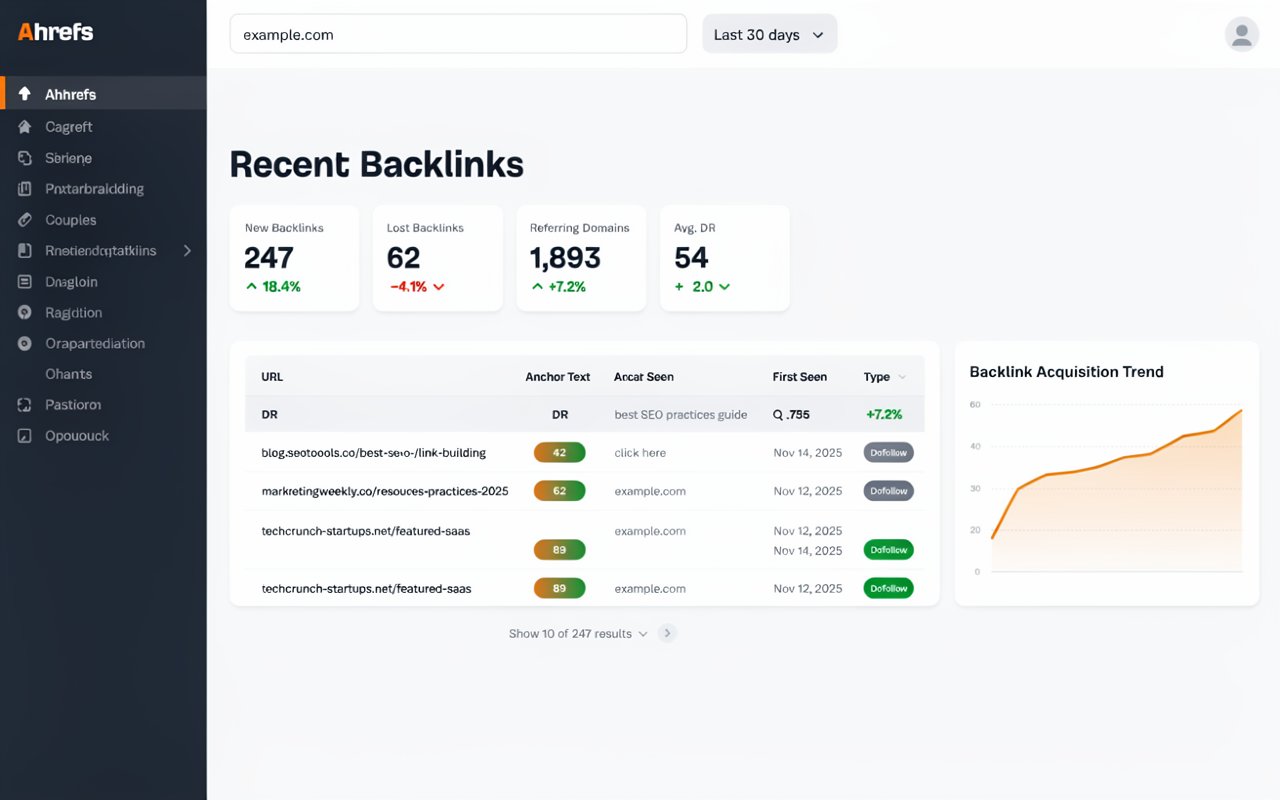
A new editorial placement goes live, a digital PR mention lands, or a partner adds a contextual citation—then your team checks Ahrefs and sees nothing. Understanding recent backlinks in Ahrefs prevents premature conclusions about campaign performance and helps you separate a genuine acquisition issue from a crawler-timing issue.
Ahrefs does not report a backlink at the exact moment a publisher clicks “publish.” It can report the link only after its crawler discovers, revisits, and processes the referring page. For agencies, in-house SEO teams, and founders measuring editorial outreach, that distinction is essential.
What Are Recent Backlinks in Ahrefs?
Recent backlinks are links that Ahrefs has recently discovered pointing to your domain, subdomain, URL, or folder. In practical Site Explorer workflows, you will usually assess them through the New Backlinks report, backlink date filters, and link-level timestamps such as “First seen” and “Last visited.”
The important point is that “recent” normally describes Ahrefs’ discovery timeline, not necessarily the date when the publisher originally posted the content.
A backlink can appear as new even when the article is several months old. This often happens when:
- A publisher adds your link to an existing article.
- Ahrefs revisits an older page after a long interval.
- Ahrefs discovers a previously uncrawled URL.
- A link was temporarily removed and later restored.
- A page becomes easier for crawlers to find through new internal or external links.
This is why a New Backlinks report should not be interpreted as a real-time feed of all links your site has earned.
The backlink fields that matter
When auditing new links, look beyond the referring domain and DR:
- First seen: The date Ahrefs first detected the link.
- Last visited: The date Ahrefs most recently crawled the referring page.
- Link type: Text, image, redirect, canonical, or another format.
- Attribute: Followed, nofollow, sponsored, or UGC.
- Anchor text: The clickable text around the link.
- Referring-page URL: The actual page sending the link equity or referral traffic.
- Target URL: The specific page on your site receiving the backlink.
These details reveal whether you have acquired a meaningful editorial placement or merely added another raw backlink to a report.
How Long Does Ahrefs Take to Notice Recent Backlinks?
There is no fixed timeframe. Ahrefs updates its backlink index frequently, but that does not mean every newly published or edited page is crawled within minutes.
For a new backlink, discovery may happen within hours, several days, or several weeks. The timing depends primarily on how often Ahrefs crawls the referring page.
| Link scenario | Typical discovery expectation | Main reason |
|---|---|---|
| Link on a major, frequently updated publication | Hours to a few days | Important and active pages tend to receive more crawler attention |
| Link in a new article on a credible niche site | Days to a few weeks | The page must be discovered and processed |
| Link inserted into an existing article | Days to several weeks | Ahrefs must revisit the edited URL |
| Link on a small or rarely updated site | Weeks or longer | The page may have low crawl priority |
| Link on an inaccessible or blocked page | Possibly never | Crawlers may not reach or process the content |
A sensible operational rule is to allow two to four weeks before assuming a valid placement has been missed. For low-visibility publishers, a longer waiting period may be reasonable.
Do not confuse Ahrefs’ reporting delay with Google’s own crawling, indexing, and ranking processes. They are separate systems with separate crawl schedules and evaluation methods.
Why a Live Backlink May Not Appear in Ahrefs Yet
A link can be live in a browser and still be absent from Ahrefs for completely normal reasons.
Ahrefs has not recrawled the page
This is the most common explanation. If a publisher adds your link to an old guide, listicle, resource page, or comparison article, Ahrefs needs to revisit that exact URL before it can detect the HTML change.
This can create apparent delays in outreach reporting. Your client may see the link live, while your Ahrefs campaign dashboard does not show it until a later crawl.
The referring page has weak discovery signals
Pages that receive little internal linking, sit several clicks deep in site architecture, or have no meaningful external visibility can be discovered and revisited less frequently.
A publisher can help make a new page more crawlable by linking to it from category pages, author pages, related posts, navigation elements, or XML sitemaps. That does not guarantee rapid third-party discovery, but it improves the page’s accessibility.
The link points through redirects or non-canonical URLs
A referring page may link to a redirected URL, a tracking parameter version, an HTTP variant, or a non-canonical version of your destination page. Ahrefs may attribute the link differently than expected while it processes redirects and canonical relationships.
Always test the destination URL manually and confirm that it resolves correctly to the intended final page.
Technical restrictions limit crawling
Robots directives, authentication walls, aggressive bot protection, JavaScript rendering issues, server errors, and blocked resources can all interfere with third-party crawling.
This is especially relevant for publishers using restrictive CDNs, membership platforms, staging environments, or anti-bot systems. A page that loads for a human visitor may not be equally accessible to every SEO crawler.
How to Verify New Backlinks Before Ahrefs Finds Them
Ahrefs is valuable for backlink analysis, but it should not be your only proof that an outreach placement exists. A robust link-building operation separates the commercial delivery of a placement from the later discovery of that placement in a third-party index.
For every acquired link, record:
- Publisher name and referring-page URL.
- Publication or placement date.
- Linked destination URL.
- Final resolved destination after redirects.
- Anchor text and surrounding paragraph.
- Followed, nofollow, sponsored, or UGC status.
- Placement type, such as editorial mention, digital PR coverage, resource-page link, guest contribution, or partner citation.
- Ahrefs first-seen date once it becomes available.
This workflow is particularly useful for premium editorial outreach. It lets an agency demonstrate that a placement is live and properly positioned even if Ahrefs has not yet recorded it.
For ongoing campaigns, reconcile your internal placement sheet with Ahrefs every two to four weeks. Investigate missing placements only after allowing sufficient crawl time and checking that the page is publicly accessible.
Why Ahrefs DR Should Not Decide Link Quality
Ahrefs Domain Rating, or DR, is useful for prospecting and comparing domains at a high level. However, DR is an Ahrefs third-party metric, not a Google ranking factor.
DR estimates the relative strength of a website’s backlink profile within Ahrefs’ own database. It can help you identify domains with stronger link profiles, but it cannot determine whether a link is relevant, editorially credible, safe, or commercially worthwhile.
A high-DR link is not automatically valuable. A site can have a strong DR while publishing thin content, selling excessive placements, linking to unrelated industries, or attracting little genuine organic visibility.
Assess backlink opportunities using a broader quality framework:
- Topical relevance between the publisher, referring page, and target page.
- The publisher’s editorial standards and author credibility.
- Organic traffic and search visibility trends.
- The quality and usefulness of the individual referring page.
- Contextual placement inside relevant content.
- Natural anchor text.
- The volume and nature of outbound commercial links.
- Evidence of a real audience, not just a monetised website.
- Whether the placement is likely to remain live and relevant.
For example, a contextual followed link from a respected cybersecurity publication to a SaaS security guide may be more valuable than a generic DR 80 placement from a broad lifestyle site with hundreds of outbound commercial links.
Build Links Worth Tracking
The goal should not be to make the New Backlinks report grow as quickly as possible. The goal is to earn links that remain useful to readers, support brand authority, and fit naturally within relevant editorial environments.
Prioritise sustainable acquisition methods:
- Editorial outreach built around genuinely useful content.
- Digital PR campaigns with newsworthy data, insights, or expert commentary.
- Linkable assets such as calculators, benchmarks, original research, templates, and industry reports.
- Thought-leadership contributions from credible internal experts.
- Competitor backlink-gap analysis to identify relevant publishers and content formats.
- Contextual resource-page opportunities where your page solves a real reader need.
Competitor links should inspire research, not blind replication. A backlink gap may reveal a relevant publisher, but you still need to assess the page, editorial environment, audience fit, and reason for the link.
Avoid automated link building, low-quality private blog networks, irrelevant guest-post networks, excessive reciprocal linking, and over-optimised exact-match anchors. These tactics may create a temporary appearance of growth while weakening the credibility of your backlink profile.
Frequently Asked Questions About Recent Backlinks in Ahrefs
How long does Ahrefs take to show a new backlink?
Ahrefs may find a new backlink within hours, but it can also take days or weeks. Discovery depends on how frequently Ahrefs crawls the referring page, how easily the page can be found, and whether the link was added to a newly published or older URL.
Why does Ahrefs show an old article as a new backlink?
Ahrefs reports when it first discovered the backlink, not necessarily when the publisher first published the article. The page may have been edited recently, recrawled after a delay, or newly discovered by Ahrefs through improved internal or external linking.
Does a recent backlink improve rankings immediately?
No. A recent backlink does not guarantee immediate ranking changes. Search engines must independently crawl and assess the link, while rankings depend on relevance, content quality, intent match, technical SEO, competition, and many other signals beyond backlinks.
Is a high-DR backlink always better than a lower-DR link?
No. DR measures the relative strength of a domain’s backlink profile in Ahrefs; it does not measure topical relevance, editorial quality, audience value, or page-level context. A lower-DR niche publication can provide a much stronger strategic link than an irrelevant high-DR website.
Can Ahrefs miss backlinks completely?
Yes. Ahrefs may not report a link if it cannot discover or crawl the referring page, if the page is blocked, or if the page has very low crawl priority. Treat backlink tools as strong measurement systems, not complete records of every link on the web.
Recent backlinks in Ahrefs are a useful monitoring signal, but they are not a real-time verdict on campaign quality. Verify placements directly, give crawlers time to revisit pages, and judge every acquisition by relevance, editorial integrity, and lasting value—not by how quickly it appears in a backlink report.